
Bayfield County Property Value: Three Numbers to Separate
Three numbers appear on a Bayfield County property record. Assessment value, estimated fair-market value, and sale price are not interchangeable. The assessor's value belongs to an assessment year. The fair-market estimate applies the ratio for the parcel's municipality and that same year. Sale price shows consideration for a qualifying single-property sale. Before judging a property's worth, match each figure to its source and date, because the deed, the tax roll, and the estimate answer different questions.
| Value | What It Is | Where |
|---|---|---|
| Assessed value | Value carried on the local assessment roll | NOVUS parcel card |
| Estimated fair-market value | Tax-system estimate using a municipal ratio | NOVUS / tax information |
| Last sale price | Consideration for a qualifying single-property sale | Parcel card and recorded transfer |
| Tax bill amount | Annual amount billed, not a market valuation | Tax Bill tab |
Wisconsin's assessment ratio changes by municipality and year. One countywide figure fits no one. The Department of Revenue's 2024 Bayfield County Statement of Assessment sets the ratio used to calculate estimated fair-market value on tax bills. DOR's major-class materials also compare assessed value with base value and full value. An assessment still serves tax purposes, not private appraisal. A deed price can reflect a different parcel, date, or sale circumstances entirely.
Bayfield County Property Value Fields in NOVUS
NOVUS displays a lot at once. Assessment values, estimated fair-market values, parcel size, zoning, tax history, and sale price for a qualifying single-property sale all sit on the record. It lists the assessor or local official contact too, plus parent and child parcel lineage. Check the record date and identifiers first. A value on a parent parcel may describe a different land unit than the child parcel. The NOVUS parcel view shows where values, sale information, and tax tabs connect.
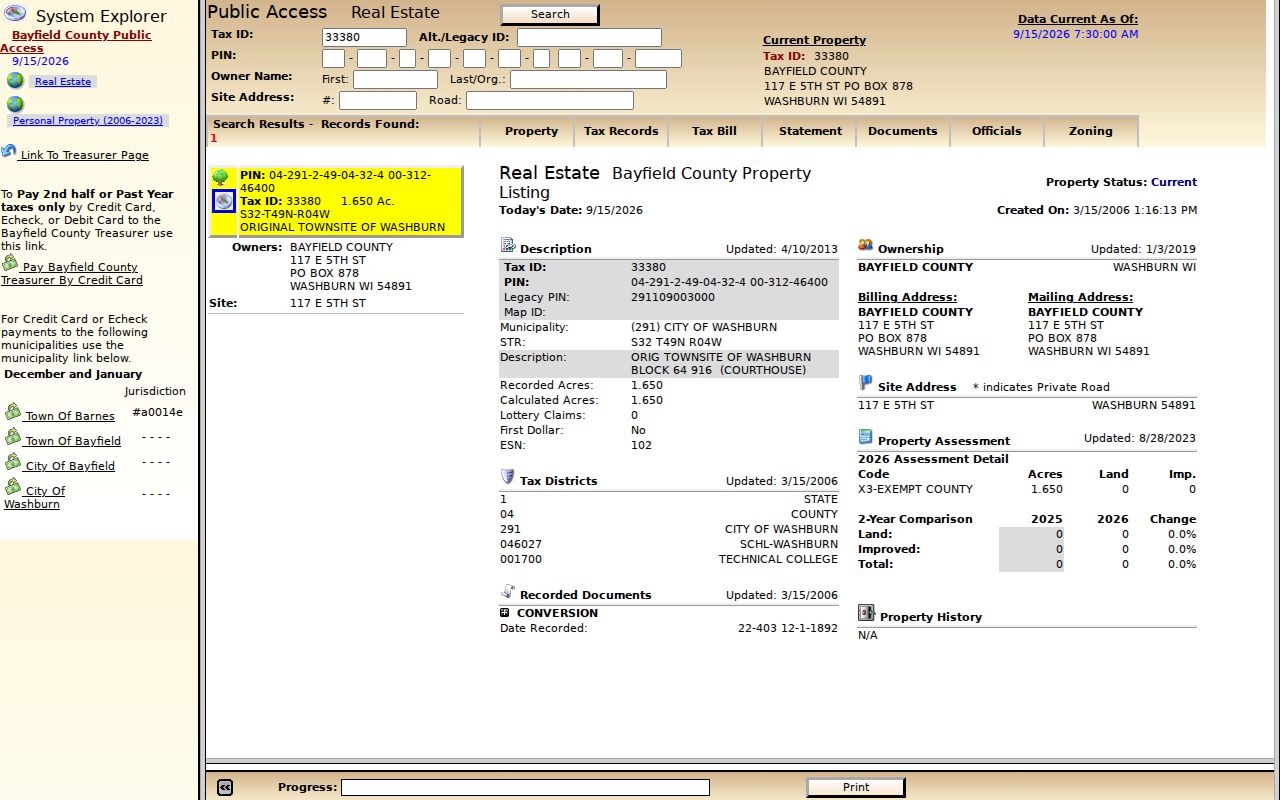
Find the numbers on a parcel card first. Then verify the correct municipal year and the underlying deed before trusting any sale figure.
Looking Up the Value of a Bayfield County Parcel
Start in NOVUS with a situs address, owner name, or county parcel number. Pick the Tax ID/PIN result. Confirm the municipality. Read the assessment and estimated-value fields beside their year. For a recorded sale price, open the document reference and verify the deed's legal description, since a number without its parcel, date, and type compares nothing.
- Search one address, owner name or Tax ID/PIN in NOVUS.
- Open the matching parcel and note municipality, assessment year and value type.
- Separate assessed value from estimated fair-market value and the last sale field.
- Use the recorded deed to confirm the land and consideration behind a sale entry.
- Assessed value
- The local assessment-roll amount for a parcel and year.
- Estimated fair-market value
- A tax-system estimate calculated using a municipality-specific ratio.
- Assessment ratio
- A comparison of assessed values with DOR base or full-value measures.
Wisconsin Ratios behind Bayfield County Property Value
The 2024 Wisconsin DOR Statement of Assessment covers Bayfield County municipalities. It reports assessed land and improvement totals. It also gives each local ratio used for estimated fair-market-value calculations. DOR explains major-class compliance by comparing assessed value with base value. The bar is within 10 percent of full value. That must happen either in the same year or at least once over five years.
These methods work at the jurisdiction level. They do not turn a parcel assessment into a current appraisal. A home in one town may be compared with a parcel in another. Use each municipality's ratio for that taxation year. No single Bayfield County ratio applies to every property. DOR sales reports rely on arm's-length sales. They also use assessment-to-sales ratios to estimate the level of assessment. Those ratios describe the whole assessment level, not the price of one house. A recorded sale is still a transaction fact. It is no guarantee of current market value.
Bayfield City's 2026 Revaluation and Property Value
The City of Bayfield has announced a 2026 revaluation. That event belongs to the city alone. It does not mean every Bayfield County municipality reassessed at once. A Bayfield mailing address may even sit inside the Town of Bayfield. Check the boundary first. Only then credit an assessment notice to the city. Compare the notice, the parcel's assessment year, the applicable DOR ratio, and any recorded sale for the same land.
The county publishes no district-level trend table or final results. Nothing supports a claim that one neighborhood rose faster than another. For a local value question, rely on the record fields and the correct year. Skip any broad price prediction. The annual tax bill and any review process appear separately. They sit on the Bayfield County property tax records page.
Municipal context matters here. The NOVUS tax explorer links a parcel's tax information with its municipal context.
The tax explorer follows one parcel's tax information. Check the value and assessment year on the record itself.
Bayfield County Sale Price versus Property Value
A deed documents a transfer and the legal description of what changed hands. That is its job. A recorded sale price only appears for a qualifying single-property sale. Many transfers involve multiple parcels or extra terms that weaken any comparison. Before weighing a deed price against an assessment, look at the document date, the grantor and grantee. Also check the parcel number and description. Splits complicate things further. A deed may have conveyed a parent tract that was later divided. Its recorded consideration does not carry over to any one child parcel.
Old prices are weaker still. At the original 1883 platting, Washburn business lots reportedly fetched $150–$250. That figure belongs to an entirely different land market. The town-site spanned 366 acres and 1,230 lots. It tells you nothing about present condition, access, utilities, zoning or parcel size. Match sales from a similar period and property context. When a decision hinges on current value, rely on an appraisal. Bayfield County assessment records trace an official value year by year. A dated deed simply proves a transaction happened. The assessor's field is not a forecast.
Parcel Splits and Bayfield County Assessment Values
Lineage matters once land has been split or combined. Under the county's modernization plan, parcel polygons generally update within a week after recorded documents arrive. Boundary changes such as splits and merges can take up to two weeks, and the GIS web map is refreshed weekly. So a child parcel may carry a different area and value than its parent record. Read the recorded CSM or deed alongside the current assessment card. Never carry the parent's amount into the new parcel.
Each figure serves a purpose. The tax bill holds the tax amount. The deed holds the transfer. A recorded survey holds the current boundary. Understanding which source answers which question explains many valuation differences, and it keeps the county's parcel page from being mistaken for a single market-price estimate.
What a Bayfield County Assessed Value Cannot Tell You
An assessed value exists for one purpose: the local assessment system. It is not a sale price, not a private appraisal, and not a title opinion. Estimated fair-market value comes from applying the assessment ratio. That ratio can shift by municipality and by year. A deed price reflects a transaction struck on its own terms. Weigh each number by its source, its date, and what it was meant to do.
Value versus price. A Bayfield County assessed value is used for taxation and is not what the property would necessarily sell for. For a current sale valuation, consult a qualified appraiser.